A new model family of multi-agent long-horizon collaboration surfaced, rumored to be GPT-6; the same day, Moonshot AI fully open-sourced Kimi K3 and closed an F round above $3.5B.
Chinese open models made the US AI sector shed hundreds of billions in a single morning for the first time.
On August 1, Moonshot AI's flagship Kimi K3 (2.8T parameters) was formally and fully open-sourced. Within two days the Hugging Face model page slowed under load and GitHub issues passed a thousand in half a day; several Silicon Valley engineers who long tracked Chinese open source said "impressive", marveling at the pace of China's AI rise. The same day, Moonshot closed an F round above $3.5B at a $35B post-money valuation.
K3's open sourcing did not stop at weights: it packaged the pre-training data distribution, the search trajectory over training hyperparameters, and the reward model from post-training alignment, all uploaded together. A researcher who ran the full K2 pipeline said what he wanted was not "another DeepSeek-V3" but K3's reasoning record of "why this hyperparameter version ultimately won": "Give only the model without the method, and the community will forever chase numbers; give the method, and the next generation stands on K3's shoulders."
Releasing full weights hands over the most expensive capability for free. This open-source move forces the closed camp to redo its math.
Moonshot AI Kimi K3 · official image · 2.8 trillion parameters fully open-sourced
Per The Information, OpenAI is preparing a new model family called Astra, focused on multiple agents collaborating over long periods on hard tasks, usable for large projects or advanced mathematics. Altman demonstrated it to US policymakers and regulators this week; the model may undergo federal review before release under a new frontier-AI review framework. Astra may be named GPT-6, or ship as GPT-5.7 in the GPT-5 series.
From "single-agent conversation" to "multi-agent project teams", OpenAI has moved the product imagination from the chat box to the workbench.
Astra surfaces: multi-agent long-horizon collaboration, rumored GPT-6.
OpenAI released a set of results in mathematics and theoretical computer science, claiming its internal Astra made progress on 10 long-unsolved problems, and published the openai/ten-proofs repository containing Lean 4 formalized proofs.
Simon Willison noted OpenAI claims each problem cost under $2,000, but did not publish how many attempts failed. What he wants to see are the prompts: "I do not want to see the outcomes; I want to see how they asked."
AI research now ships with machine-verifiable evidence chains: "solved it" is becoming "there is a checkable proof".
OpenAI publishes ten mathematical advances: the point is the Lean certificates.
"What people care about more is whether AI can give time back to people."
— Greg Brockman · OpenAI co-founder · simonwillison.net
"What I want to see is not the outcomes but how they asked."
— Simon Willison · AI researcher · simonwillison.net
Google released three embodied AI models targeting the hard problem of "when has a robot finished its task". ER 2 broke through on "temporal intelligence", accurately judging task completion states, supporting local edge deployment and rapid adaptation to new robot bodies.
Embodied deployment stalls on fine details like "how far along am I"; ER 2 fills in the robot's own mental ledger.
Google ships ER2: teaching robots to judge "is the task done".
One developer pulled K3's full weights onto a local multi-GPU machine and ran long-document analysis and code generation end to end, saying work that used to span three APIs now completes on one machine; chip vendors in the community have started building adapters too.
His setup chains eight consumer GPUs, slicing K3's 2.8 trillion parameters eight ways across tensor parallelism, about 350 billion per card. He expected "just getting it to run would be enough", but in testing, analyzing a 50-page contract dropped from 22 seconds via OpenAI to 9 seconds locally, with the document never leaving the machine. He recorded the whole first successful run on Bilibili; it passed a million views by the next day, and six GPU vendors lined up in the community to build adapters.
When a trillion-parameter model fits in your own server room, data stays home and tuning goes unrestricted: open source's real dividend is control.
Dragging Kimi K3 to local machines: my GPU runs a trillion-parameter model for the first time.
Per CYZone, Moonshot AI closed an F round above $3.5B, closing early on 3x oversubscription at a $35B post-money valuation. The G round (pre-IPO), originally planned for August, has started early with a pre-money valuation raised to $50B, targeting a Hong Kong listing within as soon as 6 months.
The open-source splash and the funding splash happened the same week, showing capital is betting on the developer network open source gathers, not on any single release.
Kimi K3 fully open-sourced at 2.8 trillion parameters, overwhelmed within two days; Moonshot closed an F round above $3.5B.
OpenAI's Astra surfaced: multi-agent long-horizon collaboration, rumored GPT-6.
DeepSeek V4-Flash will open its API for free.
Google shipped the ER2 embodied model, focused on task-completion judgment.
On one side, the strongest model given away free as open source; on the other, multi-agents moved onto the workbench. Both of the day's main lines push AI's "usability" forward.
Lake Coatepeque, El Salvador — NASA's satellite captured, around N13.8 W89.5, a pool of blue held inside a volcanic crater, still water left behind by plate tectonics in Central America.
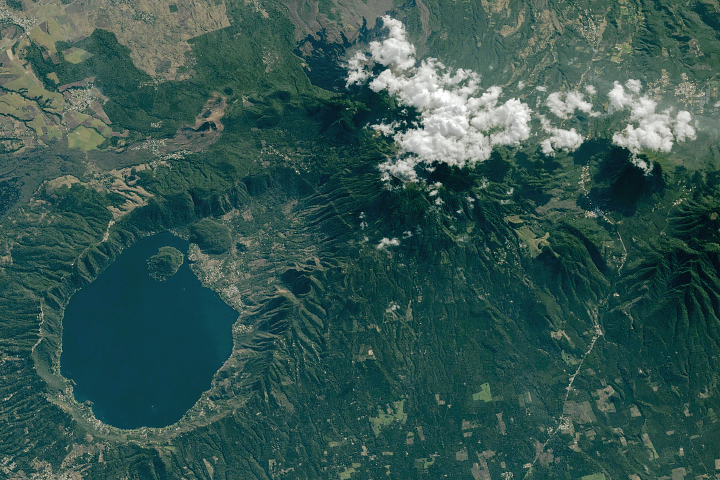
Lake Coatepeque crater · El Salvador · photographed by NASA · 13.8°N, 89.5°W
A pool of blue rests in the crater, still water left to Central America by plate tectonics. While we argue on screens about who owns which model and where compute goes, the Coatepeque volcano mirrors the same sky at its own pace. After a day of AI news, Earth still has places that need no GPU cooling. Mountains and seas — stay curious, keep exploring.