Below, who is running faster.
Qwen3.8-27B: an open model that runs on a home GPU
Alibaba's Qwen team open-sourced Qwen3.8-27B, with weights live on Hugging Face and ModelScope. Benchmarks surpass Claude Opus 4.6 Max, yet the model is small enough to run locally on a consumer GPU.
The timeline is worth noting: on August 12 Qwen released its 2.4T flagship Qwen3.8-2.4T-A95B (hyperscale, datacenter-only), on the 13th the 27B weights went live (briefly pulled, sparking delay rumors), and on the 14th international outlets like The Decoder picked it up. A big flagship for brand, a small model for adoption: two moves in as many days.
What does 27B mean? It is not another "downloadable but unrunnable" giant; it lands squarely in the "actually usable by ordinary people" range: local deployment, no API fees, no data leaving your machine, while benchmarking above top-tier closed models like Claude Opus 4.6 Max.
When "open weights plus runs at home" starts beating closed flagships, the logic of model distribution inverts: you no longer buy access; whatever you can run is yours.
Anthropic launched a watermark-detection API: external services can now check whether a text was generated by Claude.
It continues August's Claude text-watermark rollout: now it is not just Claude that knows; any service plugged into the API can verify a text's origin. For content platforms (detecting AI submissions), schools (checking homework) and enterprises (verifying output), this is the turn from "check it yourself" to "anyone can check".
Google meanwhile went the other way: allowing users to remove visible watermarks from its AI generations. The two watermark strategies are diverging: one opens up detection, the other opens up removal.
When "AI-generated" becomes publicly verifiable, "was this written by AI" turns from a trust question into a technical one, and whoever holds detection holds judgment.
X (formerly Twitter) open-sourced the For You feed algorithm, publishing recommendation weights and training code.
Recommendation algorithms have been social platforms' blackest box: they decide what you see and never explain why. By publishing For You's weights and training code, X has become the first major platform to lay its cards on the table.
For developers the direct value: study the mechanism, build third-party analyses, even train your own recommender. When "the algorithm" turns from black box to open component, "why did I see these posts" gets a verifiable answer for the first time.
MiniMax released Music 3.0 weights on Hugging Face (MiniMaxAI/MiniMax-Music3), with ComfyUI 0.33 adding native support the same day. Official words: "We will keep everything open source until AGI arrives."
On paper it is a multi-module model: an 8B global LLM (initialized from Qwen3.5-8B) plus a 0.6B local LLM plus a 2.4B flow-matching module plus a 123M Flow-VAE, generating full songs up to 5 minutes in 32kHz stereo. The API version shipped in July; this release opens the weights. Running locally means no uploads, no queues, no per-track fees: creators can finally own their AI scoring tool.
The ecological niche of open music models is subtle: closed products like Suno and Udio dominate, while open source previously had only small models. Music 3's architecture puts "five-minute full songs" within local reach, and with ComfyUI workflows an ordinary creator can assemble a complete AI music pipeline on their own machine.
MiniMax's logic is open source in exchange for ecosystem: from H2 to Music 3 it keeps open-sourcing flagship capabilities, feeding its brand through the developer ecosystem. Against Suno's subscription model, the open route bets on the flywheel of more users leading to more improvements leading to faster iteration. For creators, it is optionality: those who dislike per-track fees or uploading data can just run it locally.
When Chinese companies' open source spreads from "model parameters" to "creative tools", the battlefield widens past developers to every creator.
Alibaba released Qwen3.8-Max open weights: 2.4T total / 95B active MoE with only about 4% activation, priced at $2/$6 per million tokens via API. Community verdict: "one of the largest open-weight releases ever".
Third-party evaluations are strong: Frontend Code Arena #4 (Elo 1668, behind only Claude Opus 5 and Kimi K3), Vision Arena #2 (1305, 13 points from Claude Fable); Vals composite index 66.1, second among open models and tenth of all 43; SWE-bench 87.3%, ahead of GPT-5.5 (82.6%) and GLM-5.2 (83.3%). More valuable is the improvement curve: Vals rose from 3.7 Max's 57.5 to 66.1, an 8.6-point gain in two and a half months, while prices fell from $2.5/$7.5 to $2/$6.
The ecosystem was ready on day one: vLLM day-0 support plus dedicated 4-bit quantizations for NVIDIA B300 and AMD MI355X; Together and Baseten could run it immediately. But Jamin Ball poured cold water: K3 alone needs over 1TB of memory to load weights, at least 8 H100s; open weights do not mean locally runnable. The initial release is also text-only, vision not yet unlocked, and license terms appear to restrict downloads from the US, EU, UK and Korea, unclarified by Alibaba at press time.
When a 2.4T open model scores near closed flagships at a fraction of the price, "the gap between open and closed" becomes "who can actually run it".
Qwen3.8-Max open weights.
Google released Gemini 3.7 Flash just three weeks after 3.6 Flash: 1M-token context, 64K output, WebDev Arena Elo of 1588, API pricing at $0.75 per million input tokens (rising to $1.50 from 2027).
The eye-catcher in the official demos is 3D generation: a usable 3D watch model from one sentence, at about $0.038, under four cents. 3D modeling used to be billed by the designer-hour; now it is one sentence plus four cents. When generation cost becomes negligible, "can you model" stops being the barrier and "do you want to make it" becomes the question.
Watch the iteration cadence even more than the features: only three weeks between 3.6 and 3.7. Google is compressing releases from quarterly to monthly, and the Flash line has become the fast lane for trialing new capabilities: cheap, quick to iterate, steadily gaining abilities. The same event added the Nano Banana image model and Gemini Omni, completing a full product matrix.
For developers the direct implication: capability grows by the month, so vendor choices must be remade by the month. Last quarter's optimum may already be displaced by a cheaper new version.
The collapse of 3D content production cost may cut deeper than image generation did, because 3D is the foundation of manufacturing, games and e-commerce, and it is turning into a sentence: "make me one of these".
OpenAI introduced Computer History in ChatGPT for Mac desktop, replacing the screenshot-based Chronicle research preview. It targets Pro, Business and Enterprise users, is off by default, and requires admin authorization on enterprise plans.
How it works: instead of screenshots, it uses macOS accessibility APIs to record clicks, keystrokes, shortcuts and app switches, producing memories and timelines that ChatGPT/Codex can reference. Events upload to servers to generate memories; OpenAI says they are not retained after processing and not used for training. Interaction events stay local for up to 48 hours; the first rollout excludes the EEA, Switzerland and the UK.
Why it matters: this is the first step from "AI remembers what you said" to "AI remembers what you did" at screen level. Before, AI remembered your conversations; now it remembers your actions. For agent scenarios that is a qualitative change: ChatGPT can pick up where your last browser session left off, without you re-explaining context.
Media reaction was blunt: The Register called it "a friendly keylogger". It improves personalization but raises token consumption and prompt-injection risk, which OpenAI's own docs acknowledge, suggesting pausing it when others' communications are involved. Critics note prompt injection can poison long-term context through this memory channel.
When AI starts recording your screen, users usually click "agree" before reading the terms of the convenience-for-privacy trade. This time, the terms read "keylogger".
ChatGPT launches "Computer History".
Suno released Studio 2.0, adding MIDI import/recording/editing (usable as generation prompts), a dual-oscillator wavetable synthesizer, track automation curves and built-in effects (distortion, delay, reverb, compression, EQ), available to Premier users the same day.
The most notable update is the Chat panel: custom plugins can be created in natural language, free of credits during launch. AI music tools are turning "mixing" into conversation too. Premier users get unlimited 32-bit/48kHz multitrack and stem exports, with advanced stem separation also arriving.
Suno says MIDI was Studio's most requested feature, and 2.0 was built on a year of user feedback, aiming to upgrade Studio from "simple AI editor" to "full DAW-style production environment". What does MIDI change? You can import a melody you played yourself and have AI arrange on top of it: human-AI collaboration moves from "giving a sentence" to "giving a real performance".
The creator tiers are clear: Pro users refine with the new synths and effects; Premier users take unlimited multitrack exports into commercial-grade mixing. Competition among AI music tools is shifting from "who generates longer songs" to "who plugs into professional workflows", and DAW-grade capability is the dividing line.
When AI music starts benchmarking against professional production tools, inspiration-to-finished-track compresses to minutes. Writing melodies stops being scarce; conducting AI becomes the skill.
Suno Studio 2.0: AI music goes professional DAW-style.
Image: Suno official.
Anthropic signed a 20-year compute lease (through June 2048) with bitcoin miner Riot Platforms: 191 MW of critical IT capacity, about $9.1B in initial contract revenue, up to $16.1B with two five-year extensions.
The deal details are hardcore: Riot's Texas facility delivers 96 MW in December 2027 and the remaining 95 MW by June 2028; Morgan Stanley provides bridge financing; AMD is another tenant in the same park. The mining farm is becoming an AI compute campus.
Why buy power from miners? Mining sites have industrial power, cooling and land ready-made; converting them to AI data centers costs far less than building new. Anthropic spent $6B on acquisitions while locking $9.1B of compute: competition among top labs has become capital lock-up measured in decades.
The AI arms race has shifted from "who is stronger" to "who locks up resources first", and this time the lock is on Texas electricity through 2048.
Anthropic locks in 20 years of compute.
"Zuckerberg wrote 6,500 words of AI manifesto, and said almost nothing."
— Wired review · Zuckerberg AI Manifesto · Wired
"AI is expensive."
— Ali Ghodsi · Databricks CEO, on wanting to raise $1B and taking $5B instead · TechCrunch
Today's keyword was "fast": models sped up 14-fold, one sentence yields a 3D model, and AI music went commercial.
Money chased too: hoping for $1B, Databricks took $15B, and the data layer's valuation climbed to $190B.
Once capability is good enough, speed, cost and barriers become the starting line of the next race.
The Sargassum Belt, Atlantic Ocean — NASA's satellite captured a floating algae belt spanning the ocean, like a river that breathes.
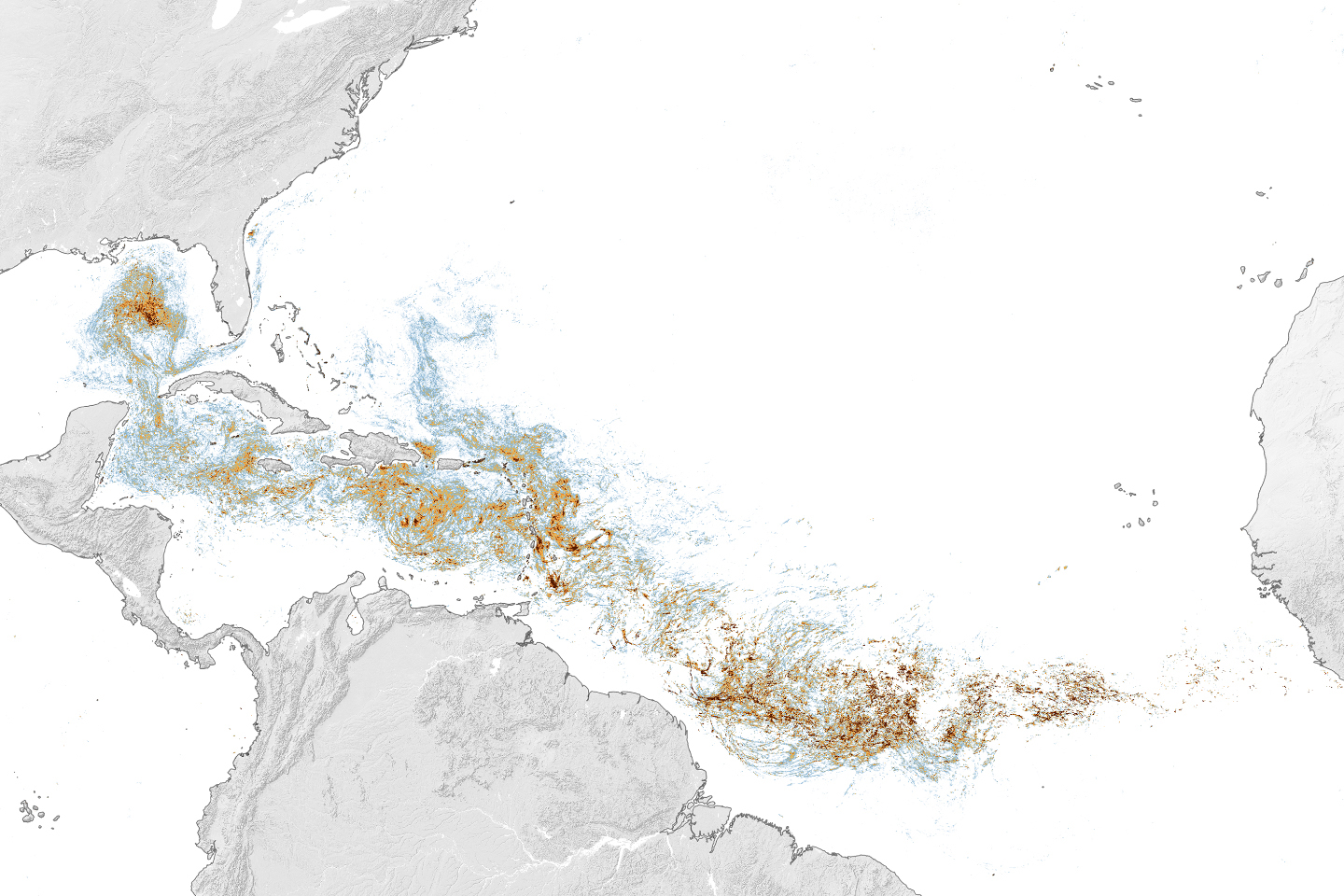
Sargassum Belt · Atlantic Ocean · photographed by NASA · 15.0°N, 45.0°W
This algae belt stretches across the Atlantic, thousands of kilometers at its widest. No company feeds it; sunlight and currents alone grow it into a "floating forest". While we argue on screens about who sped up 14-fold and whose valuation hit $190B, this belt follows the ocean's rhythm, deciding where to drift this year and which shores to reach. After a day of AI news, Earth still has places that need no GPU cooling. Mountains and seas — stay curious, keep exploring.