Below, who is running faster.
Stripe buys OpenRouter for over $7B · a payments giant grabs AI's cash register
Stripe finalized its acquisition of OpenRouter, the AI model aggregation and routing platform, for over $7 billion. The Wall Street Journal had reported talks around $10 billion; the final price came in below the rumors.
What does OpenRouter do? It is a "model interchange": developers call hundreds of models through one API, auto-routed to the best provider, with price comparison and switching built in. It makes no models; it owns the entrance to the model market.
Why would Stripe buy it? Stripe is a payments company becoming the "money layer" of the AI era: model calls are billed per token, and OpenRouter is the entrance through which all of it gets paid. Owning OpenRouter means holding the gate on "who pays for AI".
When a payments company starts buying model routers, "where AI's money flows" gets a clear checkout counter for the first time, and OpenRouter is that counter.
A leading mathematician publicly assessed LLMs: powerful calculators, lacking genuine creative thought.
A sobering counterweight to the "AI solves hard math" narrative: what AI excels at is extreme execution of known rules, computation, derivation, pattern matching, while real breakthroughs in mathematics come from the creativity of "defining new problems", exactly what LLMs lack.
Notably, this is not disparagement: calculating, deriving and verifying already make a formidable research tool. "AI is a calculator, not a mathematician": the true dividing line is whether it can ask new questions.
The Anthropic CEO on the current AI backlash: at bottom a "crisis of trust", not a crisis of technology.
The core argument: public resistance to AI is not about it being too strong or too weak; it is about not knowing whether to trust it. How data is used, whether content is AI-written, where capability boundaries lie: these trust questions are eroding the whole industry's credibility.
It echoes recent moves: Anthropic shipping watermark detection and publishing how it works are both plays in "rebuilding trust". When the industry shifts from competing on capability to competing on trust, whoever reassures users first holds the ticket to the next stage.

Mojo open source · Apache 2.0 · a portability layer that runs across accelerators
Modular formally open-sourced Mojo under the Apache 2.0 license, positioning the whole platform as a "portability layer across accelerators", covering Qualcomm's datacenter AI accelerators.
For infrastructure engineers, the point is not the "new language" itself but toolchain openness and hardware abstraction arriving together: write once, run on NVIDIA, AMD, Qualcomm and custom silicon, without rewriting per accelerator.
Why now? Accelerators are fragmenting. The chip war has made "optimize for one piece of hardware" a high-risk bet, and a portability layer has become the scarce good. As hardware splinters, whoever provides the write-once-run-anywhere middle layer stands at the entrance to the ecosystem.
NVIDIA released the TensorRT Model Connect public preview: supported Hugging Face models convert directly to end-to-end TensorRT inference, no intermediate ONNX export needed, deployed via native C++ APIs.
Every step cut from the deployment path lowers the time cost from model to production. "Two commands" means small teams can push open-source models into production quickly, without staffing an inference-optimization team.
The detail worth noting: NVIDIA itself says the project was largely built by a Codex agent under human review; implementation, tuning, testing, integration and docs all had agent participation. When an infra vendor openly admits "agents wrote our toolchain", AI developing AI goes from demo to daily routine.
Cursor published a large-scale retrospective on Git hosting: designing Git storage to database standards, holding it to database-grade reliability, scalability and consistency.
The backdrop is agent adoption: repo churn, background automation, branch and session proliferation are all growing exponentially. Git hosting has moved from "generic devops primitive" to core AI infrastructure that coding-agent backends depend on.
For ordinary developers the implication is direct: every agent completion in your IDE and every automatic branch rests on Git absorbing new load. When code hosting gets redesigned for agents, the next rebuild of the dev toolchain has quietly begun.
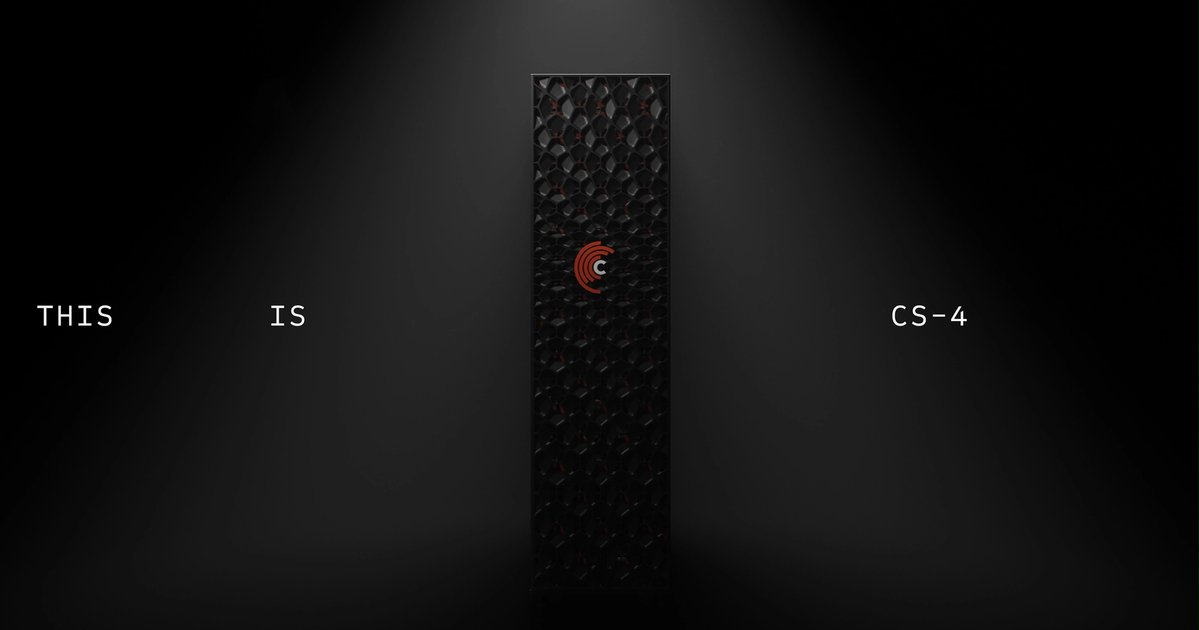
Cerebras CS-4 · 10T parameters at 1000 tok/s, 10x throughput per megawatt · the speed race reaches the datacenter
Edge and datacenter sped up simultaneously: DFlash 2 claims 70 tok/s running Qwen3.8-27B on an M5 Max, up to 4.6x faster autoregressive decoding with "identical output"; Cerebras launched the CS-4, claiming 1000 tok/s on 10T-parameter models, about 1300 tok/s for GPT-5.6 Sol, and 10x throughput per megawatt.
Vendor claims deserve a discount, but the direction is clear: inference speed is becoming product experience, unit economics and national competitiveness policy all at once. Fast is itself the selling point.
The meaning of 70 tok/s on-device is "local": no network, no uploads, privacy stays on the device, at near-real-time speed. When "fast" competes from the datacenter down to the laptop, the way AI gets used is being rewritten.

MiniMax Music 3 · 8B global LLM + 2.4B flow model, five-minute stereo running locally · native support in ComfyUI 0.33
MiniMax released Music 3.0 weights on Hugging Face (MiniMaxAI/MiniMax-Music3), with ComfyUI 0.33 adding native support the same day. Official words: "We will keep everything open source until AGI arrives."
On paper it is a multi-module model: an 8B global LLM (initialized from Qwen3.5-8B) plus a 0.6B local LLM plus a 2.4B flow-matching module plus a 123M Flow-VAE, generating full songs up to 5 minutes in 32kHz stereo. The API version shipped in July; this release opens the weights. Running locally means no uploads, no queues, no per-track fees: creators can finally own their AI scoring tool.
The ecological niche of open music models is subtle: closed products like Suno and Udio dominate, while open source previously had only small models. Music 3's architecture puts "five-minute full songs" within local reach, and with ComfyUI workflows an ordinary creator can assemble a complete AI music pipeline on their own machine.
MiniMax's logic is open source in exchange for ecosystem: from H2 to Music 3 it keeps open-sourcing flagship capabilities, feeding its brand through the developer ecosystem. Against Suno's subscription model, the open route bets on the flywheel of more users leading to more improvements leading to faster iteration. For creators, it is optionality: those who dislike per-track fees or uploading data can just run it locally.
When Chinese companies' open source spreads from "model parameters" to "creative tools", the battlefield widens past developers to every creator.
Alibaba released Qwen3.8-Max open weights: 2.4T total / 95B active MoE with only about 4% activation, priced at $2/$6 per million tokens via API. Community verdict: "one of the largest open-weight releases ever".
Third-party evaluations are strong: Frontend Code Arena #4 (Elo 1668, behind only Claude Opus 5 and Kimi K3), Vision Arena #2 (1305, 13 points from Claude Fable); Vals composite index 66.1, second among open models and tenth of all 43; SWE-bench 87.3%, ahead of GPT-5.5 (82.6%) and GLM-5.2 (83.3%). More valuable is the improvement curve: Vals rose from 3.7 Max's 57.5 to 66.1, an 8.6-point gain in two and a half months, while prices fell from $2.5/$7.5 to $2/$6.
The ecosystem was ready on day one: vLLM day-0 support plus dedicated 4-bit quantizations for NVIDIA B300 and AMD MI355X; Together and Baseten could run it immediately. But Jamin Ball poured cold water: K3 alone needs over 1TB of memory to load weights, at least 8 H100s; open weights do not mean locally runnable. The initial release is also text-only, vision not yet unlocked, and license terms appear to restrict downloads from the US, EU, UK and Korea, unclarified by Alibaba at press time.
When a 2.4T open model scores near closed flagships at a fraction of the price, "the gap between open and closed" becomes "who can actually run it".
Z.ai released the GLM-5.3 API targeting coding, defensive cybersecurity and long-horizon agents at GLM-5.2 prices; Artificial Analysis scores it 60, tying Kimi K3, after a 246-point jump to 1770 Elo on GDPval-AA v2.
The architecture did not move: still a 753B-total / 40B-active MoE with 1M context, MIT license preserved when weights land. Same skeleton, stronger results: the gains come from post-training.
A long-form Zhihu analysis supplied the technical details: asynchronous RL (SAO), executable sandbox training, and on-policy distillation against catastrophic forgetting, stacked together to power the jump. When model makers differentiate by training method rather than parameter count, competition in agent capability shifts from stacking parameters to stacking RL systems and environment quality.
Gemini 3.7 Flash · three weeks after 3.6, one-million-token context with 64K output · usable 3D models from one sentence at about $0.038
Google released Gemini 3.7 Flash just three weeks after 3.6 Flash: 1M-token context, 64K output, WebDev Arena Elo of 1588, API pricing at $0.75 per million input tokens (rising to $1.50 from 2027).
The eye-catcher in the official demos is 3D generation: a usable 3D watch model from one sentence, at about $0.038, under four cents. 3D modeling used to be billed by the designer-hour; now it is one sentence plus four cents. When generation cost becomes negligible, "can you model" stops being the barrier and "do you want to make it" becomes the question.
Watch the iteration cadence even more than the features: only three weeks between 3.6 and 3.7. Google is compressing releases from quarterly to monthly, and the Flash line has become the fast lane for trialing new capabilities: cheap, quick to iterate, steadily gaining abilities. The same event added the Nano Banana image model and Gemini Omni, completing a full product matrix.
For developers the direct implication: capability grows by the month, so vendor choices must be remade by the month. Last quarter's optimum may already be displaced by a cheaper new version.
The collapse of 3D content production cost may cut deeper than image generation did, because 3D is the foundation of manufacturing, games and e-commerce, and it is turning into a sentence: "make me one of these".
OpenAI introduced Computer History in ChatGPT for Mac desktop, replacing the screenshot-based Chronicle research preview. It targets Pro, Business and Enterprise users, is off by default, and requires admin authorization on enterprise plans.
How it works: instead of screenshots, it uses macOS accessibility APIs to record clicks, keystrokes, shortcuts and app switches, producing memories and timelines that ChatGPT/Codex can reference. Events upload to servers to generate memories; OpenAI says they are not retained after processing and not used for training. Interaction events stay local for up to 48 hours; the first rollout excludes the EEA, Switzerland and the UK.
Why it matters: this is the first step from "AI remembers what you said" to "AI remembers what you did" at screen level. Before, AI remembered your conversations; now it remembers your actions. For agent scenarios that is a qualitative change: ChatGPT can pick up where your last browser session left off, without you re-explaining context.
Media reaction was blunt: The Register called it "a friendly keylogger". It improves personalization but raises token consumption and prompt-injection risk, which OpenAI's own docs acknowledge, suggesting pausing it when others' communications are involved. Critics note prompt injection can poison long-term context through this memory channel.
When AI starts recording your screen, users usually click "agree" before reading the terms of the convenience-for-privacy trade. This time, the terms read "keylogger".
Anthropic signed a 20-year compute lease (through June 2048) with bitcoin miner Riot Platforms: 191 MW of critical IT capacity, about $9.1B in initial contract revenue, up to $16.1B with two five-year extensions.
The deal details are hardcore: Riot's Texas facility delivers 96 MW in December 2027 and the remaining 95 MW by June 2028; Morgan Stanley provides bridge financing; AMD is another tenant in the same park. The mining farm is becoming an AI compute campus.
Why buy power from miners? Mining sites have industrial power, cooling and land ready-made; converting them to AI data centers costs far less than building new. Anthropic spent $6B on acquisitions while locking $9.1B of compute: competition among top labs has become capital lock-up measured in decades.
The AI arms race has shifted from "who is stronger" to "who locks up resources first", and this time the lock is on Texas electricity through 2048.
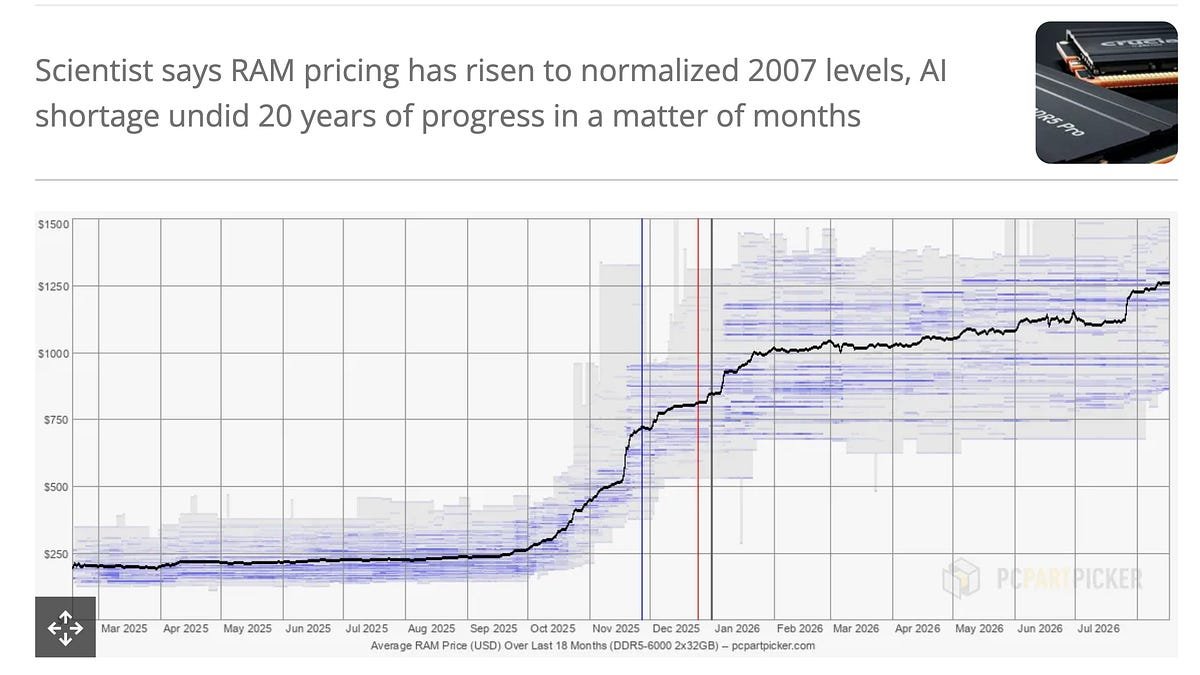
DRAM RAMageddon · 128GB DDR5 kits at 10x their lows; hyperscalers have locked nearly all 2027 capacity
Tom's Hardware calls it "RAMageddon": 128GB DDR5 kits cost ten times their historical low, and memory prices rose roughly 500% in twelve months.
The supply side is harder still: hyperscale buyers have reportedly locked nearly all global DRAM capacity for 2027, paying deposits just to guarantee supply. By weight, mainstream DRAM chips are worth more than half as much as pure gold.
Daniel Lemire's observation stings most: memory pricing is back to 2007 levels, erasing about twenty years of progress, a historical anomaly. When Moore's Law runs backwards in memory, AI's cost structure is being quietly rewritten: beyond compute, storage has become the new scarce resource.
"Zuckerberg wrote 6,500 words of AI manifesto, and said almost nothing."
— Wired review · Zuckerberg AI Manifesto · Wired
"AI is expensive."
— Ali Ghodsi · Databricks CEO, on wanting to raise $1B and taking $5B instead · TechCrunch
Today's keyword was "fast": models sped up 14-fold, one sentence yields a 3D model, and AI music went commercial.
Infrastructure sped up too: Mojo open-sourced, deployment in two commands, Git treated as a database.
But memory rose 500% back to 2007 levels. Fast has a price.
Once capability is good enough, speed, cost and barriers become the starting line of the next race.
Utah desert solar array, USA — NASA's satellite captured a million solar panels laid out like a blue ocean, a man-made oasis.
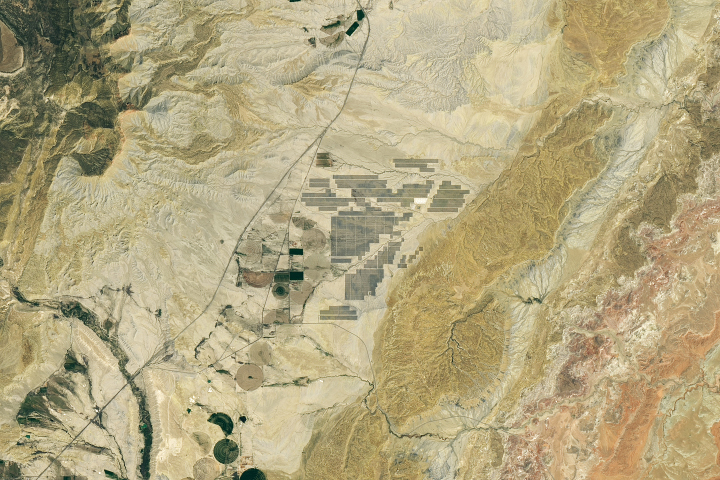
Million Panel Project · Utah · photographed by NASA · 38.0°N, 113.0°W
A million solar panels spread across the desert as a blue matrix, turning the least hospitable land into a power source. While we argue over acquisitions and model rankings, this array generates electricity at the sun's pace and asks no one's opinion. After a day of AI news, Earth still has places that need no GPU cooling. Mountains and seas — stay curious, keep exploring.