Below, who is paying for what.
Mistral released Agentic Search, turning retrieval into a multi-step loop of five tools: search, open, navigate, read, grep. On 368 SEC filings, roughly 53,900 pages of corpus in FinanceBench, accuracy rose 47–53 points over one-shot RAG, up to 59 on the full loop.
The more interesting figure is the bill: the full loop spends 24%–34% fewer tokens than search-only, because the model stops fetching wrong documents repeatedly. The cost is equally priced: p90 latency of 154 seconds, averaging 71. It suits earnings reports, contracts and scanned documents where answers hide in table footnotes, not conversations that need instant replies.
When retrieval's bottleneck shifts from "did you find it" to "did you read it", RAG competition moves from vector stores to an agent's ability to turn pages.
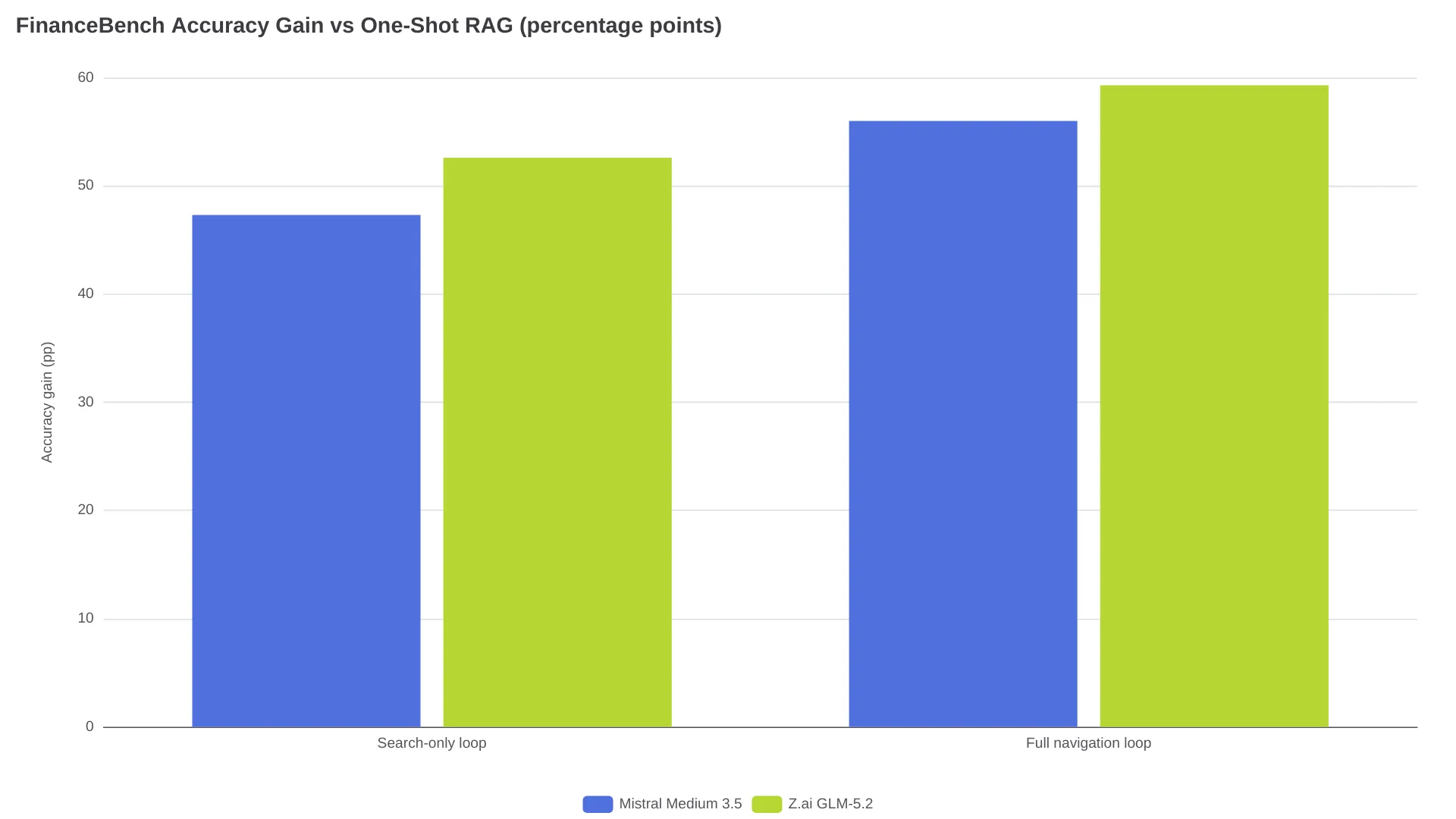
FinanceBench accuracy comparison · five-tool loop versus one-shot RAG (data compiled by AIReiter)
Perplexity opened the Agent API to all developers: a single endpoint reaching 41 frontier models from 9 providers, with web search, code execution and MCP connections built in, assembling the retrieval pipeline per request.
This step folds model routing, the search layer, sandboxing and monitoring into one bill: Sonar customers migrate by default, and in 45 days the Agent API becomes the only entrance. When orchestration itself becomes the product, comparing single models gives way to comparing whole runtimes.
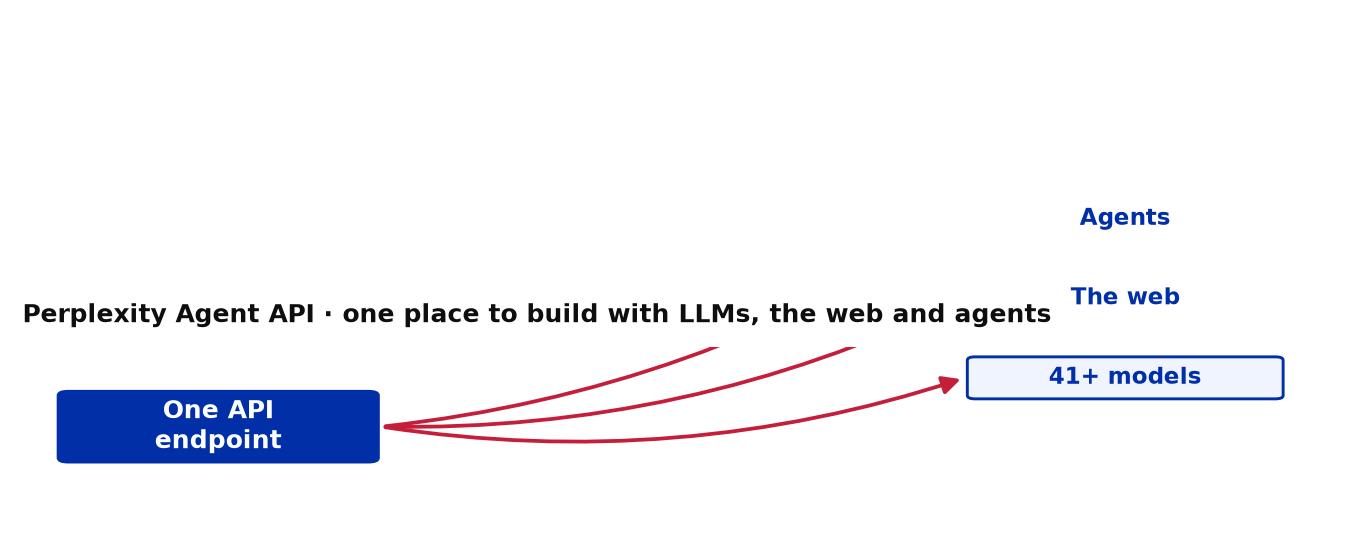
Structure diagram: Agent API folds models, web retrieval and agent capabilities into one endpoint
Promptwatch tracking shows ChatGPT search making large-scale use of site: operators to fence in sources, with Reddit citations notably down; Simon Willison tried to verify whether the system prompt had changed and found no smoking gun.
For anyone in content distribution, this is a platform unilaterally rewriting traffic rules: whether your content gets cited depends on a prompt you cannot see. After SEO, answer-engine optimization enters its black-box era too.
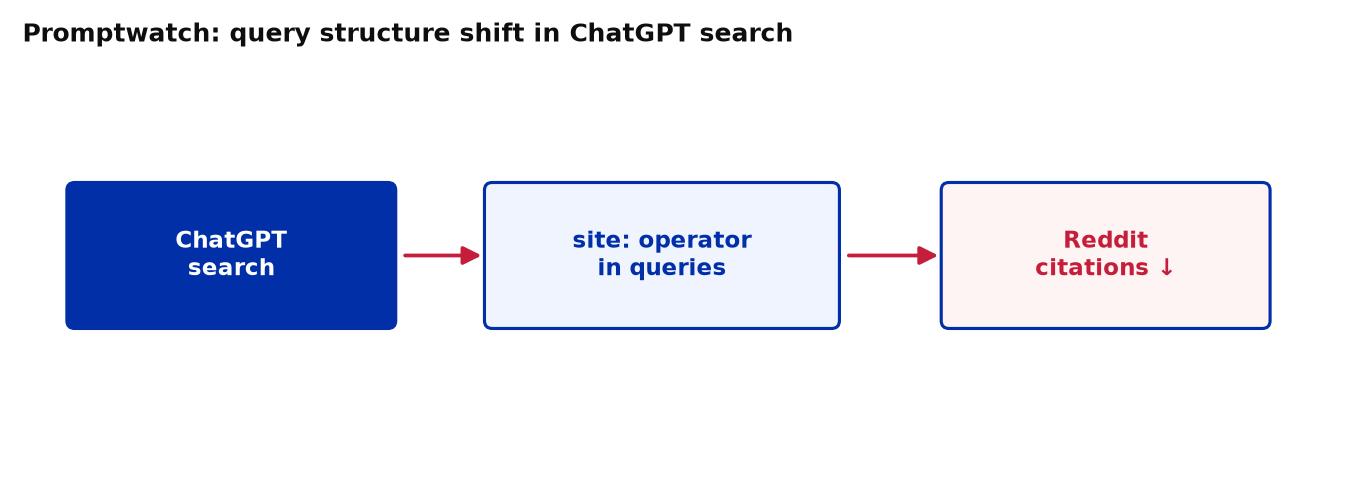
Promptwatch: how citation structure shifted after ChatGPT search adopted the site: operator
Alibaba launched Qwen-UI-Agent, a real-world-centered GUI agent foundation model covering mobile, desktop, web and deep-research environments.
The ambition sits in the words "real world": beyond understanding screenshots, it must click accurately and navigate successfully on live interfaces. When an agent's hands reach from APIs to screens, every screen without an API becomes a programmable entrance.
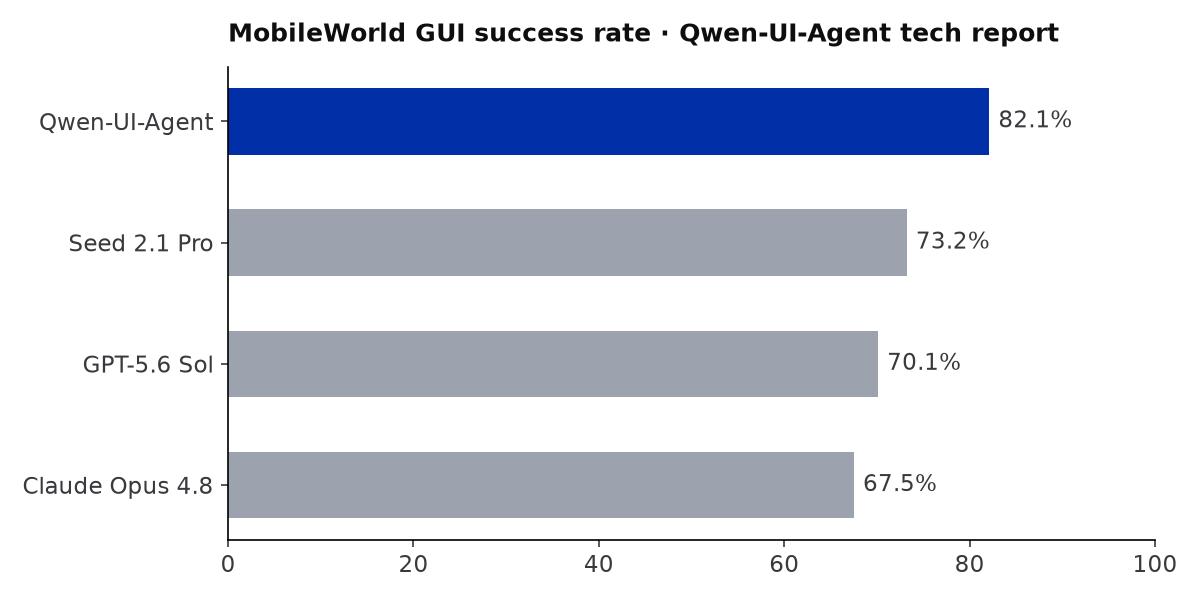
MobileWorld results: Qwen-UI-Agent at 82.1%, ahead of frontier models (technical report data)
Modular announced at ModCon that the Mojo language is now open in its entirety, with the compiler and toolchain under Apache 2.0 (with LLVM exception) on GitHub. Mojo hit 1.0 a week ago; the source-stability promise came first and open sourcing followed through.
The move after Qualcomm's acquisition points at heterogeneous computing's foundation: one codebase across CPUs, GPUs and various accelerators, with MAX also turning source-available. Compiler patches open for contributions this year-end; the standard library has taken PRs since 2024.
When AI's software foundation starts to unify, write-once, accelerate-everywhere finally has a credible starting point.
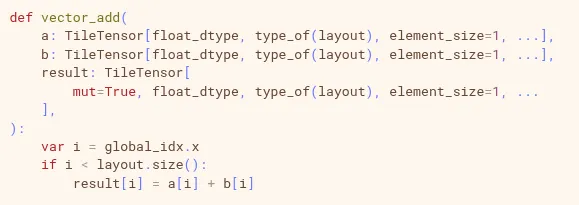
Mojo's GPU kernel syntax · language-level abstraction reaching accelerators directly
Bun 1.4 shipped as the first stable release after the Rust rewrite: 2,900+ fixes, idle CPU down to one-fifth, memory savings up to 35%, Linux startup 50% faster.
Most worth watching is the experimental Bun.WebView: a headless browser built into the runtime, using system WebKit on macOS and CDP elsewhere. Simon Willison built a shot-scraper-style JSON API in about 150 lines of TypeScript, running full Chrome in just 192–256MB of memory.
When scraping and automation become an agent's daily chores, building them into the runtime beats installing a pile of dependencies.
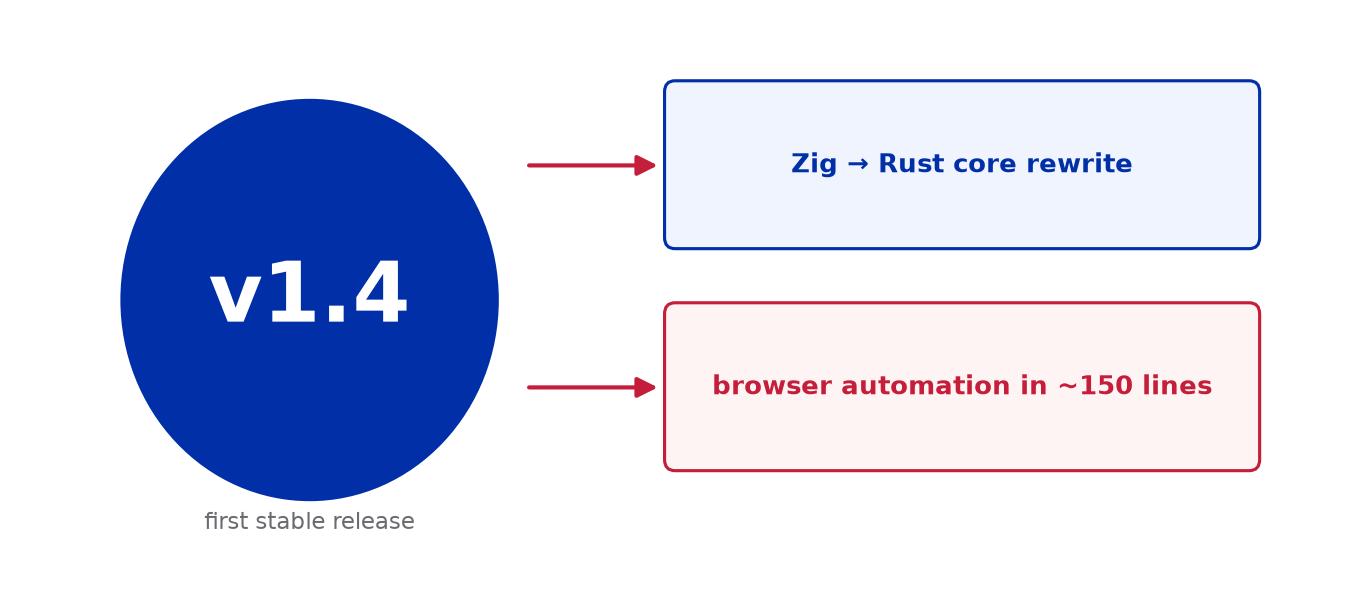
Bun v1.4 major release visual: stable after the Zig-to-Rust core rewrite.
"Mistral wrapped Perplexity-style search into a native agent tool, saving us from writing fragile scraping pipelines ourselves."
— AbdoKerdawy · AI product developer · X
"Entering the era of heterogeneous computing, open standards can accelerate collaborative deployment across GPUs, CPUs and all kinds of accelerators."
— Sid Sheth · d-Matrix founder and CEO · ModCon 2026
"America still leads, but the high prices of frontier models are getting harder and harder to sustain."
— FinanceYF5 · Finance commentator on X · X
Frontend engineer Daniel Vaughn released the experimental editor HuzZah: you write declarative pseudocode in a .hz file, and on save the editor uses the diff as a prompt to generate real code, leaving pseudocode and code side by side as a persistent record of intent.
The starting point is concrete: after finding himself working almost entirely through coding agents, prompts were used and discarded, and the agent wandered deeper into confusion across complex codebases. Storing "what I want" as a file gives the agent something to trace back to. The project is still at proof-of-concept stage, and HN discussion remains skeptical about multi-file scenarios.
When AI writing code becomes the default, where intent is stored becomes a new engineering problem.
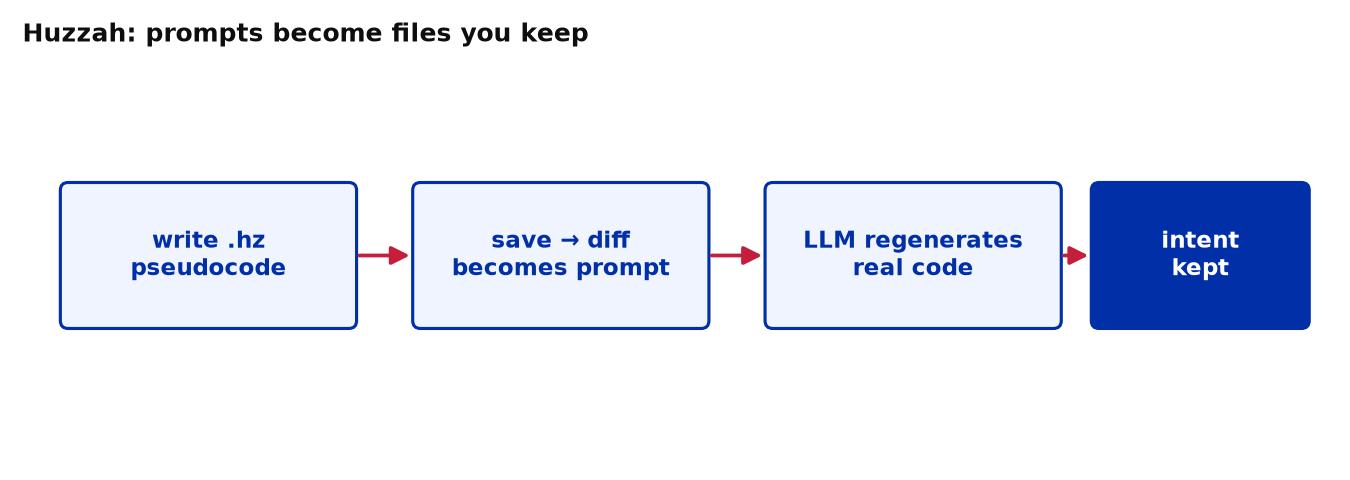
HuzZah workflow: saving .hz pseudocode regenerates real code with the diff as prompt
Black Forest Labs' FLUX Video Upscale is live on OpenRouter: one API call upscales any video to 2K or 4K, focusing on facial detail and texture restoration.
Video super-resolution joining a model-routing platform means it has become an ordinary per-call capability, priced like text models. When quality repair becomes a one-line API, old footage libraries need revaluing.
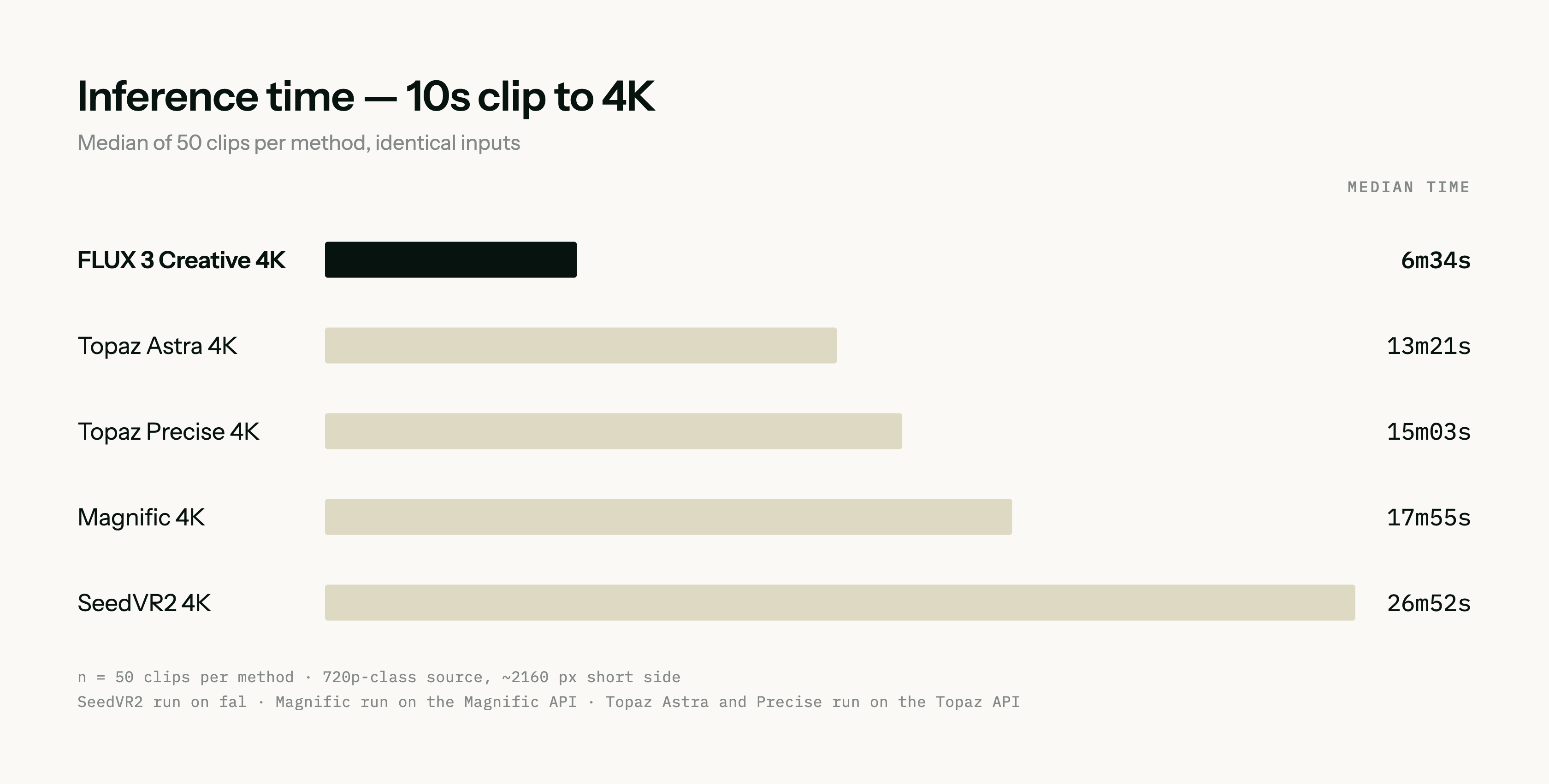
FLUX Video Upscale inference time · latency by resolution and tier (official data)
Per TechCrunch, AI training-data company Micro1 took just eight months to grow its gross annualized run rate from $100M to $500M; net of revenue share, roughly $150–200M annualized, still behind Mercor ($2B) and Handshake ($1B).
The growth logic is contract scale: doctors, lawyers and scientists enter by contract to teach models, and top labs' demand for high-quality human data shows no ceiling. Some researchers have started guessing that future spending on data may rival spending on compute.
When models finish competing on parameters and start competing on data, experts' time becomes the new upstream resource.
Today's throughline: fast things are getting accurate, accurate things are getting slow, each paying its own price.
Retrieval learned to turn pages, trading minutes for accuracy.
Routing folded into the runtime; one endpoint governs forty-one models.
Search results depend on a version of a prompt you will never see.
Good models were reminded not to overthink.
The compiler walked out of its closed walls.
Browser automation shrank into one hundred fifty lines.
Where intent is stored became a new engineering problem.
Experts' time rose to a half-billion-dollar annual run rate.
When every step carries a bill, choice is worth more than speed.
New Zealand's southern wilderness — Stewart Island, the country's third largest island, where humans are outnumbered by birds.

Stewart Island / Rakiura, New Zealand · 46.90°S, 167.80°E
Eighty percent of the island is national park; tens of thousands of penguins and parrots push people to its edges. After a day of AI news, Earth still has places that need no GPU cooling. Mountains and seas — stay curious, keep exploring.