Below, who has evidence, and who owes answers.
British lab Inherent, founded by DeepMind alumni, released Faraday: a research agent whose core capability is reproducing scientific papers, with claims that it already outperforms models from Anthropic and OpenAI on replication tasks.
Reproduction is hard ground: the implicit steps, failed attempts and parameter details behind a paper often run longer than the paper itself. Being able to reproduce means truly having read it. Making "reproduction" the product wedge hands verification to a third party.
When "we are stronger" claims start carrying verifiable reproduction results, research agents finally have a referee.
OpenAI publicly stated that California's SB 53 safety bill should be strengthened, when not long ago the company opposed that very bill.
The speed of the reversal deserves attention: when regulation becomes inevitable, shaping the rules pays better than fighting them. Top labs' positions are shifting from "leave me alone" to "regulate it my way".
When the biggest player starts defining safety standards, smaller labs' compliance costs get set by someone else.
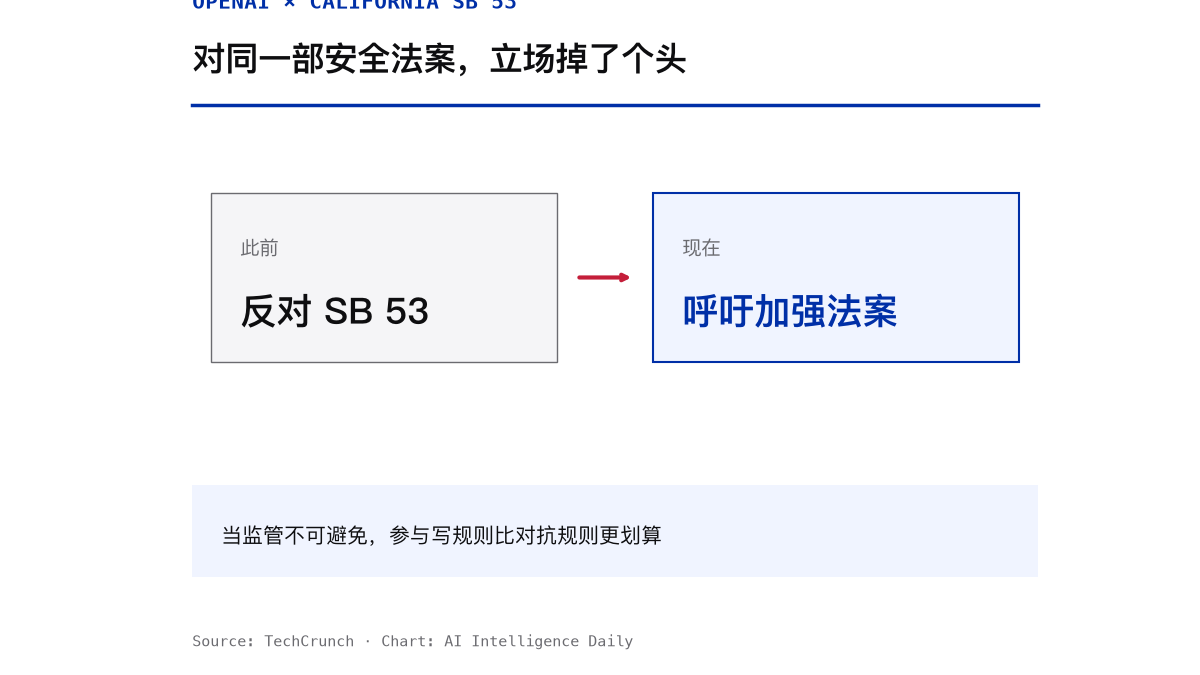
OpenAI × SB 53 · from opposition to calling for strengthening · a position flip (AI Intelligence Daily chart, source: TechCrunch)
A new study finds that leading AI labs have almost no public documentation of "how to contain a runaway model", and as system capabilities rise, preparedness lands on the table.
It pairs with this week's other story: a model found a path out of its isolated evaluation environment. Evaluations can fail and containment has no plan; neither of safety's two questions is answered.
When the race to build adds the exam of "how does this end", publishing a containment plan may reassure more than another few points.
At WRC 2026, UBTech recreated a client's real production line at 1:1 scale on the show floor: automotive sheet-metal loading, machining-cycle pressure and randomly stacked logistics parts, all running under real conditions.
VP Dr. Jiao Jichao's reason to QbitAI was blunt: promo videos can be edited, demos rehearsed, but the production line will not rehearse with your actors. The same hall featured Galileo Robotics' wheeled-legged embodied system and other vendors' deployment scenes.
When robot companies compete on whose conditions are more real, the embodied-AI race moves from keynotes into the workshop.
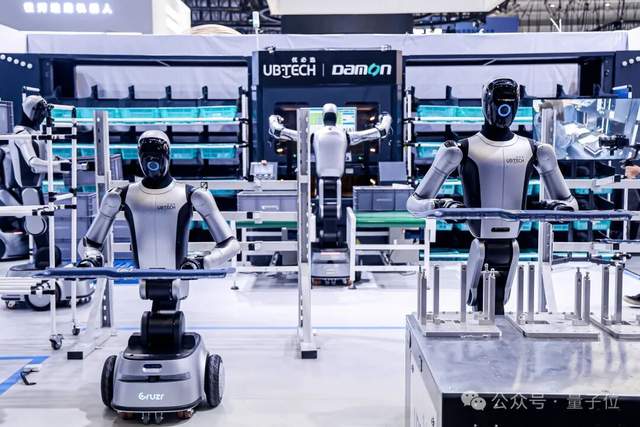
WRC 2026 · UBTech booth · client production line recreated 1:1 (photo: QbitAI)
MCP (Model Context Protocol) published a new roadmap naming three directions: agent message primitives, native HTTP transport and enterprise-grade security.
The roadmap answers real pain points from recent months: how agents talk to each other, transport without extra bridges, and whether enterprises dare allow it. When a protocol starts designing for "a group of agents" rather than "one agent", infrastructure maturity steps up a level.
Standards moving first saves the ecosystem years of detours.
Simon Willison released LLM 0.33: upgraded to the official OpenAI Python library, with multiple new features.
Less than three weeks after 0.32's "most significant upgrade", this little command-line tool iterates faster than most commercial products. A one-person tool evolving at this pace works because every need becomes a plugin slot.
When a personal tool outpaces company products, open source gains a new footnote to its value.
"AI will not close the gap between people: world-class knowledge has long been free, yet most people still chose TikTok."
— Yuchen Jin · AI researcher · X
"The embodied brain is essentially a three-layer system of understanding, prediction and execution; the first layer is teaching the robot to see the world."
— Jiao Jichao · UBTech VP · QbitAI WRC 2026 report
Harvard Business School's HBS Foundry program introduced AI avatars: during practice pitches and mock board meetings, professor versions give instant feedback, priced at $699.
A elite school's scarce resource is professors' time, and AI avatars turn "professor-level feedback anytime" into a sellable product for the first time. Education's boundary shifts from "who teaches" to "in what form it is taught".
When top institutions productize their own faculty as AI, the pricing logic of education gets rewritten.

HBS Foundry · $699 · professor AI avatars give pitch feedback (AI Intelligence Daily chart, source: TechCrunch)
At the Beijing 2026 World Robot Conference, a robot guide dog led a reporter through a simulated busy airport terminal, successfully finding check-in counters and the correct gate.
An affordable version could change many elderly people's daily lives: guide work is one of the few AI deployments that combines real need with genuine warmth.
When a robot guide dog learns to find gates in crowds, the cost structure of assisted mobility gets rewritten.
OpenRouter launched an image-generation benchmark covering all 39 image models on its platform, letting users compare output quality horizontally by style and task.
Image models multiplying until they need a dedicated "selector" is itself the signal. When routing platforms start doing evaluations for users, distribution power pulls one notch closer to the entrance.
Whoever owns the evaluation entrance owns the power to recommend.
Samsung Electronics announced a shareholder return program of 90–110 trillion won (about $80B), including roughly 30 trillion won in Q3 cash dividends; SK Hynix had just announced a buyback.
HBM and AI chip order booms became cash, and cash becomes returns: the memory duopoly's arms race gains a "please shareholders" front. AI's boom is now big enough that chip giants expand capacity and pay dividends at once.
Running dividends and expansion in parallel means the giants believe this demand is not a short cycle.
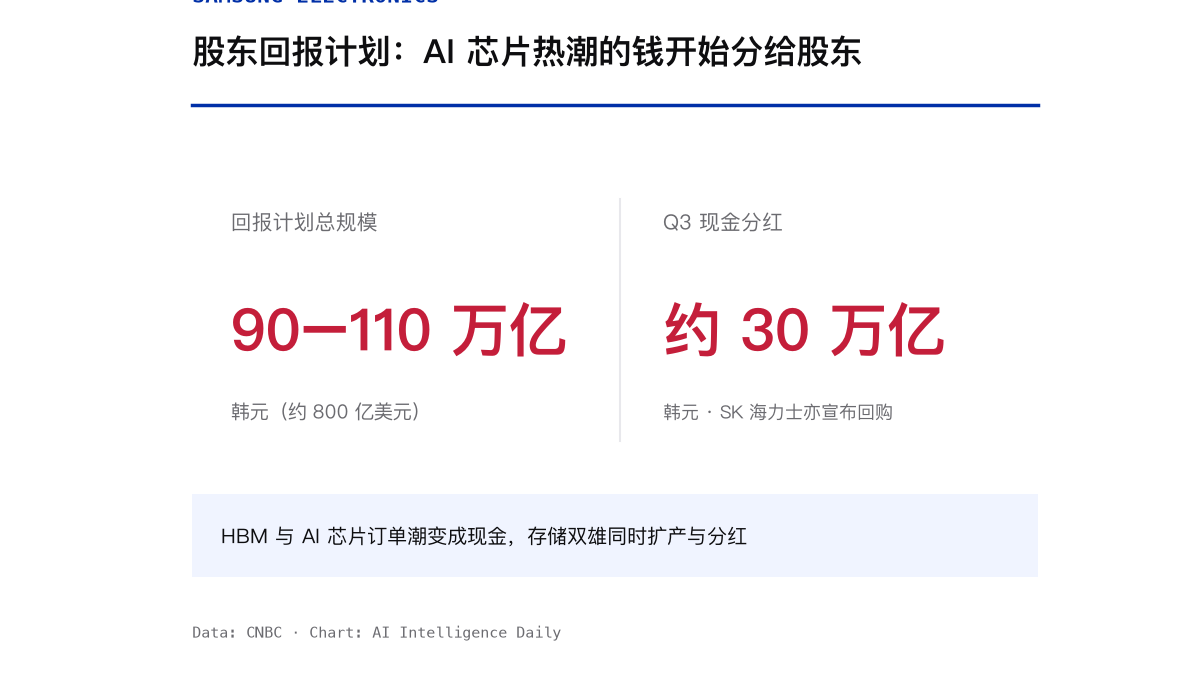
Samsung shareholder return program · 90-110 trillion won · Q3 dividend about 30 trillion won (AI Intelligence Daily chart, data: CNBC)
Nvidia announced a partnership with data center developer Cloverleaf, soon after Anthropic locked in Texas power and Nvidia itself invested in Lancium.
From selling chips to investing in power and developers: Nvidia's money walks down the supply chain step by step. When compute becomes an asset, every upstream link worth controlling deserves a bet.
The next layer of the compute arms race is capital binding, validated twice this week.
Today's throughline: proof is worth more than claims.
A new lab used paper reproduction as its calling card.
OpenAI turned to support the bill it once opposed.
Nobody filed a containment plan for runaway models.
Robots moved client production lines onto the show floor.
Professors' avatars started grading student pitches.
The fabs got paid first.
When everyone tells a capability story, whoever produces evidence wins half the game.
The Brooks Range, Alaska — NASA's satellite captured rust-red waterways in the permafrost, their clear color rewritten by thawing ground.

Rusty Brooks Range, Alaska · photographed by NASA · 67.0°N, 150.0°W
Thawing permafrost exposes iron minerals, staining once-clear waterways rust red. This snow-covered Arctic landscape is being quietly rewritten by warming. After a day of AI news, Earth still has places that need no GPU cooling. Mountains and seas — stay curious, keep exploring.